When people discuss early literacy, they often focus on read-alouds, alphabet songs, or encouraging children to learn sight words. Those are important, but they don’t tell the whole picture. What often gets left out is the foundation of learning, the part that begins before letters and decoding, when children are just starting to figure out how language, relationships, and ideas work in their world.
Yes, we want kids to learn how to read. However, the pressure to arrive early can lead to skipping over what builds strong, confident readers. At three and four years old, we sometimes forget that children are still developing across every domain—cognitive, social-emotional, physical, and language. Literacy doesn’t live in isolation. It grows out of play, conversation, and curiosity.
This post centers on early literacy, but it recognizes that literacy is just one part of a much larger picture. We’re focusing on how free play supports that piece, especially during the Pre-K years, when learning should still feel open, meaningful, and full of discovery.
Key notes
- Literacy starts long before sight words; it’s built through stories, play, and conversation.
- Children become readers by first becoming storytellers.
- The best literacy tools in Pre-K? Loose parts, real-life props, and time to imagine.
- Play that reflects home life builds connection and deeper language use.
- A responsive Pre-K classroom values how kids speak, feel, and make sense of the world.
What Is Free Play and Why Does It Matter in Pre-K?
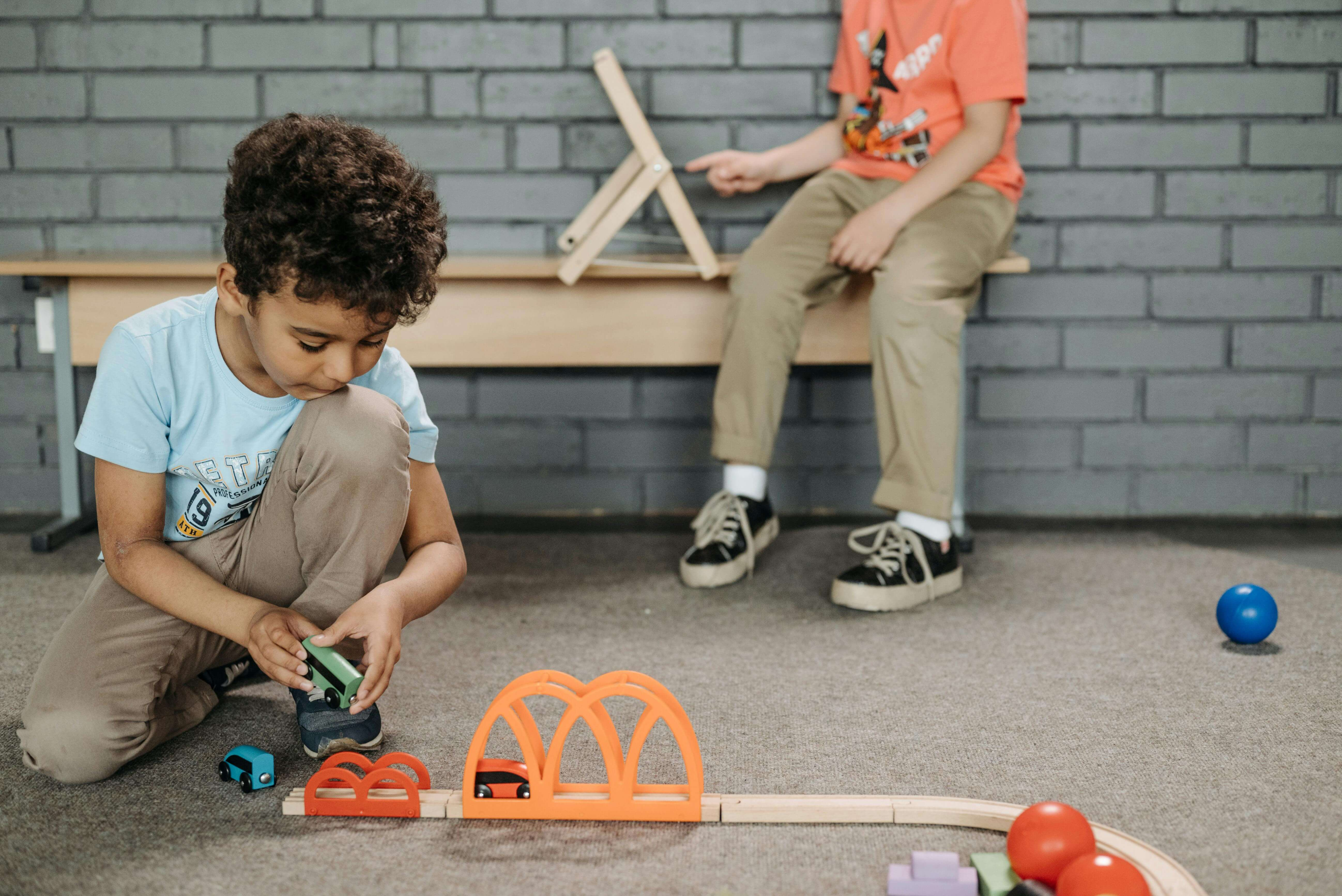
Free play is child-led, open-ended, and rooted in imagination. It’s the kind of play where a plastic plate becomes a steering wheel, or a group of kids decides to build an entire grocery store out of cardboard and masking tape. There are no adult directions, no specific outcomes. Children follow their ideas, work through conflicts, and explore language on their terms.
In most Pre-K settings, whether that’s public school classrooms, private preschools, charter programs, or home-based care, play is often structured into defined centers. These include dramatic play, blocks, fine motor areas, science exploration, reading corners, sensory tables, and writing stations. These centers can support learning, but adults still curate them. Materials are rotated in, themes are set, and the expectation is that children will engage in specific ways, even if it’s playfully.
This is quite different from what typically occurs in most kindergarten classrooms, where the environment tends to be more structured. Students often work at desks with name tags and complete worksheets that prioritize academic readiness over exploratory learning. While routines and structure have their place, this shift usually leaves behind the open, messy, imaginative learning that supports deeper growth.
For children ages 2 to 4, learning should be hands-on, social, and responsive to their developmental stage. These are years of enormous growth, language is expanding, emotions are intense, and motor skills are still developing. Free play meets those needs in a way worksheets can’t. It supports early literacy not just through exposure to print, but through meaningful communication, storytelling, and pretend scenarios that help kids make sense of the world.
How Free Play Builds Early Literacy
Free play doesn’t always look like literacy, but the skills that show up during play are often the earliest signs of it. In child-led play, you’ll hear storytelling, see symbols emerge, and watch language come alive in ways that are entirely natural for children. These are the building blocks of literacy, even if there’s not a letter in sight.
Here are a few ways free play supports literacy development in Pre-K:
- Oral language and vocabulary: When children talk through their ideas in dramatic play, negotiate roles with friends, or narrate their actions in block play, they’re strengthening the language they’ll later use to read and write.
- Print awareness: Children begin to recognize that print has meaning when they create signs for their pretend store, write labels during art time, or “read” a menu aloud while playing at a restaurant. These experiences help them understand how print works in the world around them.
- Emergent writing: Free play naturally invites early writing. A child might scribble a note for a pretend doctor visit, make a grocery list, or draw symbols that represent something important to them. These early marks are part of the writing process.
- Sequencing and comprehension: Acting out a story, retelling what happened during play, or even deciding what comes next in a pretend scenario builds narrative thinking and sequencing skills. These are key foundations for reading comprehension later on.
What makes these moments powerful is that they’re driven by the child’s own interests and lived experiences. In culturally responsive classrooms, this looks like play that reflects children’s real lives. Maybe it’s a pretend bodega, a barbershop setup, or a cooking scene that mirrors a family recipe. When children see their world reflected in their play space, their language deepens, and their connection to literacy becomes personal.
SEL and Literacy: They Grow Together
Social-emotional learning and literacy aren’t separate skills that develop on their own tracks. In early childhood, they’re woven together. When children play, they aren’t just building language; they’re also learning how to take turns, manage frustration, and express themselves in ways others can understand. That connection shows up in free play in:
- Perspective-taking: When children role-play or act out different scenarios, they begin to understand how others think and feel. This supports both empathy and deeper comprehension.
- Conflict resolution and negotiation: Disagreements are part of play. Working through them builds language for problem-solving and emotional expression skills they’ll use in both relationships and storytelling.
- Self-regulation and routine: Literacy routines in Pre-K are often embedded in play transitions. Singing a clean-up song, recalling what happened in centers, or sharing a favorite part of play during circle time all help children build memory, reflection, and verbal skills.
Culturally responsive literacy supports SEL by honoring where each child comes from, how they speak, how they express emotions, and what stories they know. When children feel seen, they’re more likely to engage. And when their stories matter, their literacy development becomes something rooted in identity, not just instruction.
What This Looks Like in Practice
Supporting free play as a foundation for early literacy doesn’t mean abandoning structure. It means trusting that children learn best when their ideas lead the way and providing them with the tools, space, and language to do so. Whether you’re in a Pre-K classroom or setting up learning at home, here are a few ways to support literacy through free play:
- Offer open-ended materials: Items such as loose parts, paper, clipboards, fabric scraps, writing tools, and labels invite children to create their narratives. Avoid “one right way” activities and lean into materials that can be used in multiple ways.
- Create space for storytelling: Encourage children to tell you what they made, what’s happening in their block structure, or what their stuffed animals are doing. These conversations are the early stages of narrative building, and they matter.
- Use signs and symbols: Label areas with both words and pictures. Invite children to create their signs for the pretend areas. This helps build print awareness in a way that feels useful and empowering.
- Make room for lived experiences: Stock your dramatic play area or home bins with items that reflect your children’s real world, such as food boxes, cooking utensils, dress-up clothes, or photos. Culturally responsive literacy means children see their lives in the stories they tell through play.
- Connect play to reflection: After center time or playtime, have a brief circle where children can share what they did, what they learned, or what they would like to play next time. These reflections help build sequencing and vocabulary skills naturally and organically.
The goal isn’t to control the play; it’s to be intentional about how we support it. When we recognize that play is a literacy-rich space, we start to see children as capable thinkers and communicators long before they pick up a book.
Why It All Matters
Free play is not a break from learning. It is the learning. It’s where children try out language, explore emotions, tell their stories, and figure out how the world works. When we honor that, we shift our role from instructors to facilitators, from directing what literacy “should” look like to listening for the rich, authentic literacy that’s already happening.
Early childhood education should be a space where all children are seen, supported, and invited to grow as whole people. That starts with trusting the power of play.
Want the free printable?
Drop your email below, and I’ll send over your copy of “Literacy-Rich Play Invitations for Pre-K.” It’s a snippet of easy setups that spark big ideas and rich language, whether you’re teaching in a classroom or learning at home.